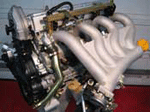
3D Printed Intake Manifolds

Naturally aspirated tech and talk
michaelmount123
Posts: 298
Joined: Fri Jul 09, 2021 7:51 am
Has thanked: 26 times
Been thanked: 178 times
I believe it's time to create intake manifolds with 3D printing. My cursory Google search tells me there are several suitable materials, so why not? There are intake manifold designs that are far superior to the factory designs where performance is the goal, and a clever single manifold design could accomodate both NA, turbo, and even ITB and plenum/single throttle body designs. I'm admittedly ignorant of the process, particularly how CAD generates the product. There are commercial outfits out there that offer the service, but past experience has shown that our community prefers a price conscience product, and ideally one that is proven in its performance attributes. So what do the 3D printing experts think, and what does the community think? I'm curious to know.

GTR Intake Plenum.jpg
GTR Intake Plenum.jpg (1.67 MiB) Viewed 14172 times
944 4V Webers2.JPG
944 4V Webers2.JPG (2.65 MiB) Viewed 14172 times
Targa944 003.jpg
Targa944 003.jpg (144.1 KiB) Viewed 14172 times

#1

User avatar
Tom
Site Admin
Posts: 8581
Joined: Fri Jun 25, 2021 2:04 pm
Location: Silicon Valley, CA
Has thanked: 893 times
Been thanked: 3854 times
Contact:
Well, you know I'm in!

Some disorganized thoughts... Hobbyist printers have gotten remarkably good in the last few years. You can now print parts in carbon-fiber infused nylon with relative ease, whereas just a few years ago that was something of a holy grail process to master. The Bambu Lab material I use is good to 380F, so should have no problem at all under the hood, assuming it's not silly close to hot exhaust. To the extent the design exposes the material to gas (or methanol) it would be important to find a material that doesn't react (or design in metal inserts for injectors possibly). The issue with hobbyist printers is that most are not big enough to print a full 944 intake manifold as one big part. There are some large format hobbyist printers out there, but most would struggle with the high-temp materials like carbon-fiber nylon. Realistically, it probably makes most sense to print prototypes and test pieces in a common material like ABS or even PLA, refine the model just the way you want it, then have it printed on a commercial printer.

In terms of the design, I can do basic CAD stuff -- not an expert at all though, so hoping someone else here might be up for the challenge. Other than copying an existing part, I imagine we'd need to start with a mechanical drawing of some kind -- or at least detailed sketches showing when you have in mind. Bonus points if the design is modular so smaller individual parts can be printed on regular sized printers. :)

#2

michaelmount123
Posts: 298
Joined: Fri Jul 09, 2021 7:51 am
Has thanked: 26 times
Been thanked: 178 times
I'm quite sure a 944 intake manifold could be made in 4 pieces with only minor changes to the cylinder head flange bolt pattern. Here is one I had machined for a 4V using the ATPower throttle bodies. It resulted in a GORGEOUS piece of kit, but was pretty pricey. Unfortunately the engineering company wouldn't give up the CAD files.
Add Pictures/Files
Intake Man Newest.jpeg
Intake Man Newest.jpeg (37.54 KiB) Viewed 14145 times
ATPowerTB's.jpeg
ATPowerTB's.jpeg (63.1 KiB) Viewed 14145 times

#3

adonay
Posts: 32
Joined: Sun May 05, 2024 6:03 pm
Has thanked: 2 times
Been thanked: 4 times
I am skeptical after 3d printing different materials for several years i believe the more common FDM style 3d printer is not suitable for such a task.
Allow me to elaborate : While getting a 3d printer to operate in a heated cabinet and print at 260c is a non issue these days and can be done relatively cheap we have issues with layer binding between the printed layers. It can best be described as a weld that has a crack in the middle . Even at a 100% infill. There are several machines that cut a piece of carbon fiber thread and bond it between the layers these are extremely expensive and time has shown that even if you order a print like this it will still crack over time. We learned this when ordering window brackets for a lightweight racing boat.
I have printed allot of nylon parts several ASA and ABS part for engine compartment use and as long as they are no where near the hot exhaust and under no mechanical stress they hold up quite well . If i Try to print something that is tugged on constantly it will eventually crack between the layers, think support for cooling hose\ intake and MAF connected to a intercooler pipe etc. I have experimented with this for some time on different cars and currently using 3d print parts for my AOS delete. I think they will fail but i have the cad drawings that i can send in and have cnc alu parts within days.

Dealing with allot of bmw s54 engine groups the question has always been to make a more cost effective carbon fiber box by using a 3d printed version . I know a few have tried, some did a part in 4 sections and glued them together and that failed only by mounting the box . 1 guy got it right he used PVU water dissolvable filament and put real carbon fiber on top and dissolved the internal PVU part . The latter is perhaps the way to go Print a mold and coat the epoxy and Fiber on top then dissolve the PVU in a tank with a water pump.

I am now experimenting by using epoxy resin on Taulman Nylon and a High quality ABS to see if it will fill the layer gaps and actually make the part mechanically stronger .

Problem is also that fuel gets into the intake and we need to find a plastic that can be 100% resistant to the harsh environment . Aswell as being able to take the vibrations and heat involved in an engine compartment .

I know metal 3d printing is getting more and more common and maybe printing services in the future will be much cheaper . This way a working plastic prototype can be developed and the files can simply be uploaded to these print services .Metal 3d printing is similar to normal SLS (Sinter Laser) printers but the printed part will go into a Forge oven and then a cure cabinet.

So the difference between FDM 3d printing and Injection molded ABS+ASA plastics is that there is no air inside the part that is injection molded while the fdm part is packed with weak layer bindings.

I do not currently have a SLS printer nor will i be able to afford a printer large enough to make a whole intake manifold but this is the type of printer you would want to use for this kind of part as it does not have any particular X,Y, or Z weakness.

#4

User avatar
Tom
Site Admin
Posts: 8581
Joined: Fri Jun 25, 2021 2:04 pm
Location: Silicon Valley, CA
Has thanked: 893 times
Been thanked: 3854 times
Contact:
adonay wrote: Mon May 27, 2024 7:27 am I am skeptical after 3d printing different materials for several years i believe the more common FDM style 3d printer is not suitable for such a task.
Allow me to elaborate : While getting a 3d printer to operate in a heated cabinet and print at 260c is a non issue these days and can be done relatively cheap we have issues with layer binding between the printed layers. It can best be described as a weld that has a crack in the middle . Even at a 100% infill. There are several machines that cut a piece of carbon fiber thread and bond it between the layers these are extremely expensive and time has shown that even if you order a print like this it will still crack over time. We learned this when ordering window brackets for a lightweight racing boat.
I have printed allot of nylon parts several ASA and ABS part for engine compartment use and as long as they are no where near the hot exhaust and under no mechanical stress they hold up quite well . If i Try to print something that is tugged on constantly it will eventually crack between the layers, think support for cooling hose\ intake and MAF connected to a intercooler pipe etc. I have experimented with this for some time on different cars and currently using 3d print parts for my AOS delete. I think they will fail but i have the cad drawings that i can send in and have cnc alu parts within days.

Dealing with allot of bmw s54 engine groups the question has always been to make a more cost effective carbon fiber box by using a 3d printed version . I know a few have tried, some did a part in 4 sections and glued them together and that failed only by mounting the box . 1 guy got it right he used PVU water dissolvable filament and put real carbon fiber on top and dissolved the internal PVU part . The latter is perhaps the way to go Print a mold and coat the epoxy and Fiber on top then dissolve the PVU in a tank with a water pump.

I am now experimenting by using epoxy resin on Taulman Nylon and a High quality ABS to see if it will fill the layer gaps and actually make the part mechanically stronger .

Problem is also that fuel gets into the intake and we need to find a plastic that can be 100% resistant to the harsh environment . Aswell as being able to take the vibrations and heat involved in an engine compartment .

I know metal 3d printing is getting more and more common and maybe printing services in the future will be much cheaper . This way a working plastic prototype can be developed and the files can simply be uploaded to these print services .Metal 3d printing is similar to normal SLS (Sinter Laser) printers but the printed part will go into a Forge oven and then a cure cabinet.

So the difference between FDM 3d printing and Injection molded ABS+ASA plastics is that there is no air inside the part that is injection molded while the fdm part is packed with weak layer bindings.

I do not currently have a SLS printer nor will i be able to afford a printer large enough to make a whole intake manifold but this is the type of printer you would want to use for this kind of part as it does not have any particular X,Y, or Z weakness.
I've had decent luck with FDM parts under the hood but, as you say, none of them are under mechanical stress. In addition to the Bambu FDM printer, I also have a Formlabs SLA (resin) printer and would bet that some of those materials would hold up to most under-hood chores. Their Rigid 10K resin is incredibly strong, good to over 400F, and does not react to gasoline. That said, the build volume on the Form 3 is quite small (and a liter of that resin costs more than a lot of 3D printers....). If you could get each part down to the size of a beer can, then it may be possible on the Formlabs printer. But I'd still be inclined to do as you say and ultimately have the final version printed on a commercial SLS printer.

#5

944er
Posts: 141
Joined: Thu Sep 28, 2023 3:51 pm
Has thanked: 13 times
Been thanked: 46 times
You may consider binding the parts to a mock engine and other interfaces in order to hold mechanical tolerances, then annealing the parts at above the glass temperature of the plastics in order to increase binding, strength, and decrease porosity. This is an additional step, similar to the cure cabinet mentioned for laser sintered metal products.

#6

yugami
Posts: 52
Joined: Mon Sep 04, 2023 5:19 am
Has thanked: 14 times
Been thanked: 16 times
adonay wrote: Mon May 27, 2024 7:27 am
I have printed allot of nylon parts several ASA and ABS part for engine compartment use and as long as they are no where near the hot exhaust and under no mechanical stress they hold up quite well . If i Try to print something that is tugged on constantly it will eventually crack between the layers, think support for cooling hose\ intake and MAF connected to a intercooler pipe etc. I have experimented with this for some time on different cars and currently using 3d print parts for my AOS delete. I think they will fail but i have the cad drawings that i can send in and have cnc alu parts within days.
I think plain ABS/ASA etc is a dead wrong material for this application.

PC/ABS blends for instance are 40% stronger in tensile and have a 15% higher heat deflection temp

PC/PETG blends are also super strong and heat resistant.

The proprietary PC blend from Prussia is pretty intense.

As well as 3dxTech's EzPC CF

I love normal ABS and ASA for a lot of prints, and nylon can be very useful, but theres a lot more out there lately.

#7

adonay
Posts: 32
Joined: Sun May 05, 2024 6:03 pm
Has thanked: 2 times
Been thanked: 4 times
yugami wrote: Tue May 28, 2024 7:06 am
I think plain ABS/ASA etc is a dead wrong material for this application.

PC/ABS blends for instance are 40% stronger in tensile and have a 15% higher heat deflection temp

PC/PETG blends are also super strong and heat resistant.

The proprietary PC blend from Prussia is pretty intense.

As well as 3dxTech's EzPC CF

I love normal ABS and ASA for a lot of prints, and nylon can be very useful, but theres a lot more out there lately.
Poly carbonate is good stuff anything mixed with PETG i am not so sure about . PC is a nightmare to print as it is so hygroscopic even when using a drying cabinet maybe i should buy a better one .

#8

yugami
Posts: 52
Joined: Mon Sep 04, 2023 5:19 am
Has thanked: 14 times
Been thanked: 16 times
Theres also PC-PET (non g) but PC-PETG is pretty amazing stuff. You can't compare "pure petg" and "pure PC" to specific mixes.

#9

cp99
Posts: 111
Joined: Fri Apr 07, 2023 10:25 am
Has thanked: 4 times
Been thanked: 22 times
michaelmount123 wrote: Sun May 26, 2024 3:40 pm I'm quite sure a 944 intake manifold could be made in 4 pieces with only minor changes to the cylinder head flange bolt pattern. Here is one I had machined for a 4V using the ATPower throttle bodies. It resulted in a GORGEOUS piece of kit, but was pretty pricey. Unfortunately the engineering company wouldn't give up the CAD files.
@michaelmount123 - wow, how much would that kit cost today?
Boston-area, MA

#10

Post Reply