


Alright, I have a strange one. My rack has play on the driver side. When you turn the wheel from side to side quickly it makes a light clunking noise that you can feel in the car. I had my daughter turn the wheel side to side with me under the car and it is coming from the driver side of the rack. You can grab the tie rod and move the rack in and out only on the driver side. The tie rods are newish, steering coupler is brand new and the rack was rebuilt about 25k miles ago. The rack isn’t leaking at all either. The big question is this, can the bushing with the spring that pushes on the rack be bent out to add more tension. If memory serves me it’s a metal bushing? It sure seems that this is the issue.
I also posted this on the NA side.
Steering rack question
-
Black944 turbo
- Posts: 202
- Joined: Thu Jul 14, 2022 7:45 am
- Has thanked: 7 times
- Been thanked: 120 times

-
Black944 turbo
- Posts: 202
- Joined: Thu Jul 14, 2022 7:45 am
- Has thanked: 7 times
- Been thanked: 120 times
Thanks so much for the response. Yes, it is newish and is still tight. You can feel it inboard of the inner tie rod.

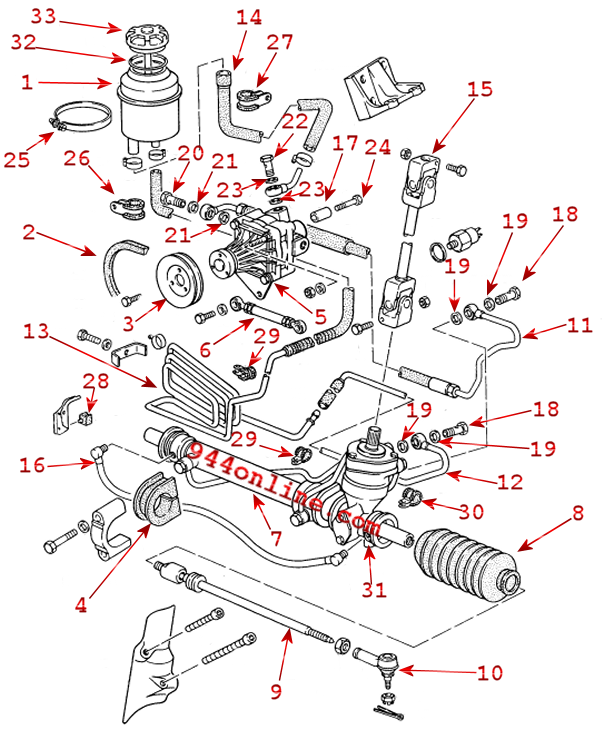
I'm not sure what you mean by " bushing with the spring that pushes on the rack" - but are you sure it's not just the mounting bushings? (#4 in the picture above). They are notorious for going soft and disintegrating from oil and power steering leaks from above, and are often mistaken for loose tie rods.
-
Black944 turbo
- Posts: 202
- Joined: Thu Jul 14, 2022 7:45 am
- Has thanked: 7 times
- Been thanked: 120 times
No, I am positive the steering rack bushings are good.
I am referring to the internal bushing in the rack. There is a cover where the ground strap bolts too. When you remove that there is a bushing that presses against the rack with a spring and then the cover on the outside. It seems that there is an issue with that bushing (metal if memory serves me) or the spring that presses against it.
Probably going to require a new rack and pinion, but hate to a replace it since it isn’t leaking a drop and was semi recently rebuilt.
I am referring to the internal bushing in the rack. There is a cover where the ground strap bolts too. When you remove that there is a bushing that presses against the rack with a spring and then the cover on the outside. It seems that there is an issue with that bushing (metal if memory serves me) or the spring that presses against it.
Probably going to require a new rack and pinion, but hate to a replace it since it isn’t leaking a drop and was semi recently rebuilt.
-
dr bob
- Moderator
- Posts: 581
- Joined: Thu Jul 08, 2021 9:30 pm
- Location: Central Oregon
- Has thanked: 232 times
- Been thanked: 233 times
The "rack" in the rack-and-pinion is one piece, so it sounds really off that you have longitudinal play in the housing but one side only.
You can use a dial indicator to measure the actual play between the tie rod and the rack housing, then the tie rod and the rack itself with the boot slid off. Best way to isolate play in the inner tie rod.
The rack itself can move radially in the housing when the end bushings are worn. The dial indicator is the detective tool of choice once again, looking for relative movement as the rack tries to move initially when pressure from the pinion changes.
In the parts diagram, there's a cover with a spring and a preload pad that work to keep the pinion fully engaged with the teeth on the rack itself. Look at the C in .com text in the image, two hex cap screws over the cover. Part of that spring duty includes loading the rack in the end bushings, making it a little bit tougher to accurately measure radial wear in the end bushings. The steering and tie rod angles push harder than you might trying to just check them by hand. Your testing and measuring would be best done with the tires on ramps or pads so the suspension is loaded as normal
You can use a dial indicator to measure the actual play between the tie rod and the rack housing, then the tie rod and the rack itself with the boot slid off. Best way to isolate play in the inner tie rod.
The rack itself can move radially in the housing when the end bushings are worn. The dial indicator is the detective tool of choice once again, looking for relative movement as the rack tries to move initially when pressure from the pinion changes.
In the parts diagram, there's a cover with a spring and a preload pad that work to keep the pinion fully engaged with the teeth on the rack itself. Look at the C in .com text in the image, two hex cap screws over the cover. Part of that spring duty includes loading the rack in the end bushings, making it a little bit tougher to accurately measure radial wear in the end bushings. The steering and tie rod angles push harder than you might trying to just check them by hand. Your testing and measuring would be best done with the tires on ramps or pads so the suspension is loaded as normal
dr bob
1989 928 S4, black with cashmere/black inside
SoCal 928 Group Cofounder
928 Owner's Club Charter Member
Former Ex Bend Yacht Club Commodore Emeritus
Free Advice and Commentary. Use At Your Own Risk!
1989 928 S4, black with cashmere/black inside
SoCal 928 Group Cofounder
928 Owner's Club Charter Member
Former Ex Bend Yacht Club Commodore Emeritus
Free Advice and Commentary. Use At Your Own Risk!
-
Black944 turbo
- Posts: 202
- Joined: Thu Jul 14, 2022 7:45 am
- Has thanked: 7 times
- Been thanked: 120 times
Hi @dr bob, you are 100% correct on measurements being the best course of action. Unfortunately, I don’t have a dial gauge. I can however visually see the movement in the rack that corresponds to the noise. It sure appears to be an internal rack issue. You are also correct that both sides should exhibit the play but it is definitely more pronounced on the driver side. Not sure if anything else can be done other than a rebuild or replacement (had horrible luck with reman racks).
-
Black944 turbo
- Posts: 202
- Joined: Thu Jul 14, 2022 7:45 am
- Has thanked: 7 times
- Been thanked: 120 times
I spent a few hours messing with the car this morning and ended up putting a small shim under the spring. This took care of 95% of the issue and the car feels nearly perfect again. Not sure if this will be a permanent fix but it made a huge difference. I can’t be happier. The spring tension didn’t seem as tight as it should be when it was removed. Not sure if this is due to wear on the bushing or if the spring has lost some of its tension over the years.
Hopefully this will help someone else in the future.
Hopefully this will help someone else in the future.